A Land Flowing With Milk and Honey: Ancient Meaning and Modern Faith Lessons
Join Our Skool Community- >>> HERE <<< - New 7-Day Study Course Added Weekly
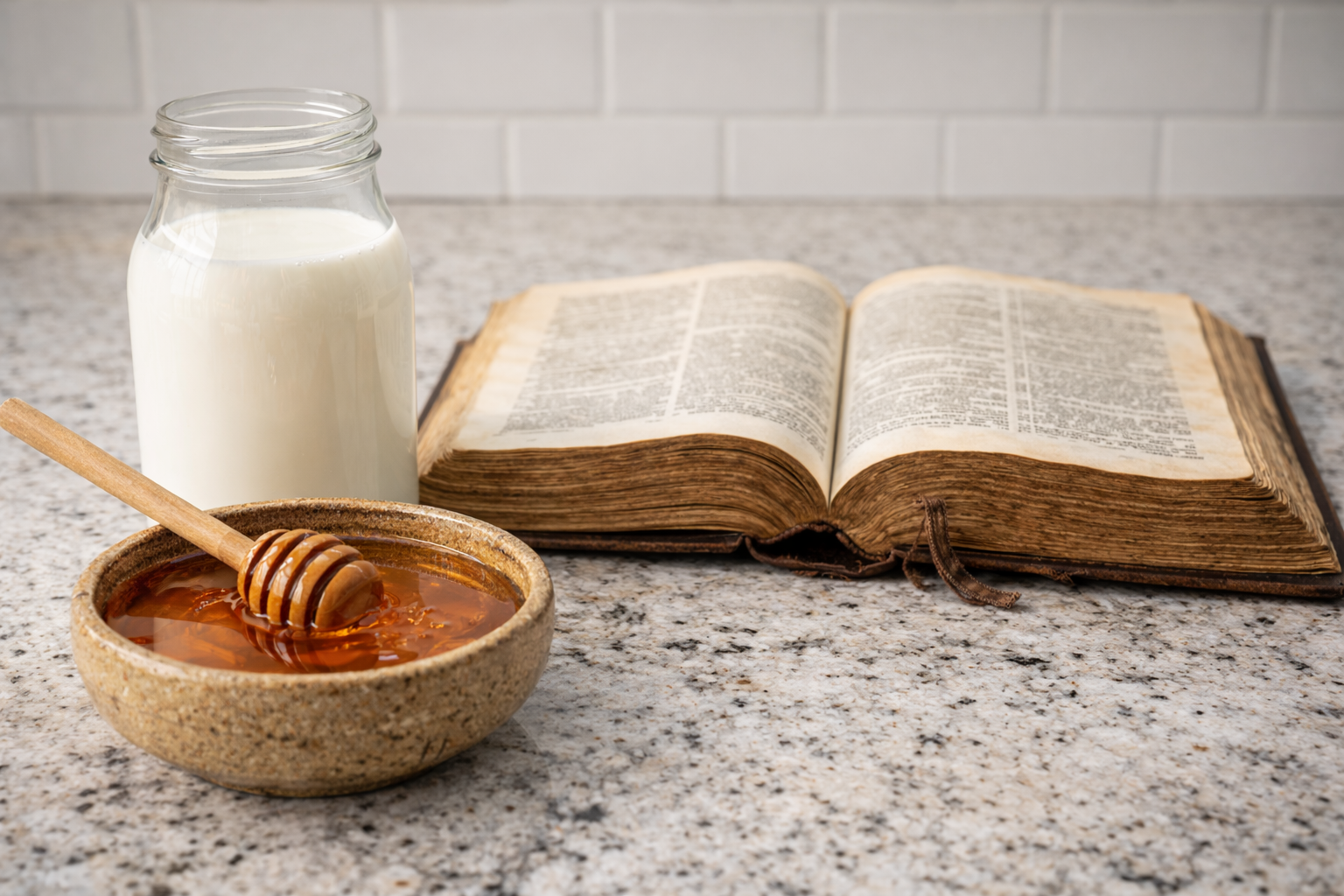
There are certain Bible phrases that feel so familiar that we can quote them without pausing to really consider them. “A land flowing with milk and honey” is one of those phrases for me.
I have heard it all my life. I have read it in Exodus. I have seen it in devotionals. I have heard preachers use it as a picture of blessing. And yet, the more I slow down and sit with it, the more I realize this phrase is so much deeper than a poetic way of saying, “Things will be nice there.”
When God described the Promised Land as a land flowing with milk and honey, He was not just dangling comfort in front of a weary people. He was revealing something about His character, His covenant, His provision, and the kind of life He was bringing His people into.
And honestly, that matters to me so much right now—because sometimes I can be so focused on getting out of a hard place that I forget to ask what kind of place God is bringing me into.
This phrase reminds me that God does not only deliver. He also prepares, provides, and plants.
The First Time We Hear It:
A Promise in the Middle of Oppression
One of the first places this phrase appears is when God speaks to Moses from the burning bush. Israel is suffering. They are crying out. They are enslaved. And God says:
“So I have come down to rescue them from the hand of the Egyptians and to bring them up out of that land into a good and spacious land, a land flowing with milk and honey…” (Exodus 3:8)
That verse moves me every time.
God did not just say, “I have come down to get them out.” He said He had come down to bring them into something good. He named the destination. He described the provision. He gave them a future in words they could hold onto.
That is so like God.
He is not only the God who breaks chains; He is the God who leads us into covenant life. He is not only the God who opens prison doors; He is the God who prepares inheritance.
I think sometimes we read “milk and honey” and picture luxury. But for Israel, this phrase would have communicated something much more practical and life-giving: fertility, nourishment, fruitfulness, sustainability. It was a way of saying, “The land I am giving you can support life. You will not merely survive there—you will have what you need.”
And after the harshness of Egypt, that mattered.
Why “Milk” and “Honey”?
When I study this phrase, I see that it is not random. God chose these words intentionally.
Milk points to flocks and herds. It suggests pasture, healthy animals, and ongoing nourishment. In a pastoral society, milk was not just a treat; it was a sign that the land could sustain life through livestock.
Honey (often understood in the Old Testament context as date honey or fruit syrup, not only bee honey) points to sweetness, abundance, and cultivated fruitfulness. It speaks of trees, dates, figs, and the richness of the land’s produce. Deuteronomy’s description of the good land includes a list of abundance, including honey among the celebrated provisions (Deuteronomy 8:7–8).
So when God says “milk and honey,” I hear Him saying something like this:
“I am bringing you to a place where your flocks can thrive and your fields can produce. I am giving you a land with nourishment and sweetness—daily provision and overflowing goodness.”
That is not a shallow promise. That is a covenant promise.
It was not merely about taste. It was about life.
The Phrase Is About More Than Material Blessing
This is where I had to slow down in my own heart.
It is easy for me (and maybe for you too) to hear “milk and honey” and immediately translate it into modern ideas of prosperity: comfort, ease, excess, “my best life.” But when I read the full story of Israel, I see that the Promised Land was never a promise of a struggle-free life.
There were battles in that land.
There were tests in that land.
There were choices in that land.
There was covenant responsibility in that land.
The phrase “flowing with milk and honey” did not mean there would be no enemies. It meant God’s promise was still good in spite of the enemies.
That is a word for me.
Because sometimes I assume that if God has truly led me somewhere, there should be no resistance. But Scripture does not teach me that. Israel entered a good land, but they still needed faith, obedience, and endurance (Joshua 1:2–9).
So the phrase points to provision, yes—but not passivity.
Blessing, yes—but not laziness.
Promise, yes—but not independence from God.
In fact, one of the dangers of the good land was that the people might enjoy the blessing and forget the Giver. Moses warned them plainly:
“When you have eaten and are satisfied, praise the Lord your God for the good land he has given you.” (Deuteronomy 8:10)
And then he continues warning them not to forget the Lord once they are full (Deuteronomy 8:11–14).
That convicts me deeply.
It tells me the “milk and honey” seasons of life may be spiritually dangerous if I stop living dependently on God.
A Covenant Phrase Repeated Again and Again
One thing that stands out to me is how often God repeats this phrase throughout the Bible. It appears over and over in Exodus, Leviticus, Numbers, Deuteronomy, and beyond (Exodus 3:8, Exodus 3:17, Exodus 13:5, Leviticus 20:24, Numbers 13:27, Deuteronomy 6:3, Joshua 5:6, Jeremiah 11:5, Ezekiel 20:6).
That repetition matters.
God was not just being poetic. He was building covenant memory.
Every time the phrase was repeated, it reminded Israel:
Who made the promise
What kind of land it was
Why obedience mattered
What inheritance they were walking toward
I need that kind of repetition in my life too.
Because I forget.
I get distracted.
I get discouraged in wilderness seasons.
I start interpreting my current circumstances as if they are the whole story.
But God repeats truth because He knows how easily we lose perspective.
When He repeats “milk and honey,” He is saying, in a sense, “Do not forget the nature of My promise. Do not let the wilderness redefine Me.”
That ministers to me so much.
The Wilderness and the Promise
I cannot think about this phrase without thinking about the wilderness.
Israel heard about the land before they lived in it. They had to carry the promise through barren places. They heard about “milk and honey” while eating manna. They heard about abundance while feeling the strain of waiting.
That is such a real picture of faith.
There are seasons in my life where I know what God has said, but I am not standing in the full experience of it yet. I am somewhere between Egypt and promise—delivered, but still journeying. Free, but still forming. Hopeful, but still hungry.
And in those moments, this phrase becomes more than geography. It becomes a testimony of God’s trustworthiness.
He does not call us to move without promise.
He does not lead us through wilderness without purpose.
He does not forget what He said.
Numbers 13 gives us one of the most vivid moments. The spies come back and say:
“We went into the land to which you sent us, and it does flow with milk and honey! Here is its fruit.” (Numbers 13:27)
I find that verse so striking because the land was exactly what God said it would be.
The problem was never the truth of God’s promise.
The problem was the people’s response to what stood in the way.
That preaches all by itself.
Sometimes the “giants” in my life try to make me question whether God’s word is still true. But Numbers 13 reminds me the presence of giants does not cancel the reality of the promise. The land can still be good even if the path requires courage.
When the Phrase Is Used Ironically:
A Warning About Distorted Memory
One of the most sobering uses of the phrase is in Numbers 16:13, when rebels speak as though Moses brought them away from “a land flowing with milk and honey”—referring to Egypt.
That is chilling.
Egypt?
The place of bondage?
The place of oppression?
The place where they groaned under slavery?
And yet in rebellion, they speak of it as if it were paradise.
This is such a warning to me about what unbelief can do to memory.
When my heart grows hard, I can romanticize what God delivered me from.
I can begin to call bondage “security.”
I can call compromise “peace.”
I can call old captivity “better than this wilderness.”
But God’s people must not let temporary frustration rewrite spiritual history.
Psalm 106 repeatedly recounts how Israel forgot God’s works and rebelled in the wilderness (Psalm 106:7, 13, 21). That same tendency lives in all of us if we are not careful.
This is one reason the phrase “milk and honey” is important even now: it teaches me to let God’s definition of blessing shape my memory, not my emotions.
The Ancient Cultural Insight:
A Whole-Life Picture of Provision
I also love the ancient cultural insight behind this phrase because it makes the image even richer.
In the world of the Bible, “milk and honey” would have communicated a land capable of supporting both pastoral and agricultural life. It was a shorthand for a balanced, fertile, productive place—one where daily needs could be met and sweetness could be enjoyed.
That balance really speaks to me.
God did not promise only necessity (milk) or only delight (honey). He named both.
He is the God of bread and feast.
He is the God of sustenance and joy.
He is the God who teaches us to pray, “Give us today our daily bread” (Matthew 6:11), and also the God who “richly provides us with everything for our enjoyment” (1 Timothy 6:17).
I think many of us have an easier time believing God for one or the other.
Some of us believe He will provide survival, but we struggle to believe He gives sweetness.
Others want the sweetness, but resist the disciplines that support daily provision.
But in this phrase, I see God’s heart for a people who will live under His blessing in a way that is grounded and grateful.
Not self-indulgent. Not anxious. Not faithless.
Just deeply aware that everything comes from Him.
The Promised Land Was a Gift—But
It Required Faithful Living
Another thing this phrase reminds me of is that inheritance and obedience go together.
God gave the land. Israel did not earn it. He said in Leviticus 20:24:
“I am the Lord your God, who has set you apart from the nations. I am the one who said to you, ‘You will possess their land; I will give it to you as an inheritance, a land flowing with milk and honey.’” (see Leviticus 20:24)
This was grace.
But grace did not eliminate responsibility. The people were called to live differently in the land. They were to reflect the holiness of the God who brought them there (Leviticus 19:2; Leviticus 20:26).
That matters for us too.
As believers, we are not saved by works (Ephesians 2:8–9), but we are saved for a transformed life (Ephesians 2:10). We do not earn God’s promises, but we are still called to walk in obedience as people of covenant.
I think this is one reason the phrase still speaks so strongly today. It reminds me that God’s blessings are not invitations to drift; they are invitations to faithful stewardship.
If God gives me a “milk and honey” season—whether in family, ministry, health, finances, or spiritual growth—I want to hold it with reverence and gratitude.
“Milk and Honey” and the Character of God
At the deepest level, I do not think this phrase is really just about the land.
I think it is about the God who gives the land.
The phrase reveals a God who:
hears the cries of His people (Exodus 3:7)
acts in history (Exodus 3:8)
makes promises and keeps them (Joshua 21:45)
provides not only rescue but inheritance
gives enough for life and enough to taste His goodness
That is why this phrase still comforts me.
Because maybe my “land” right now does not look like what I expected.
Maybe I am still in a wilderness stretch.
Maybe I am in the middle of transition, uncertainty, or delay.
But the same God who promised Israel a land flowing with milk and honey is still the God who leads His people with wisdom and love.
His faithfulness has not changed.
Hebrews reminds us that even the earthly promised land pointed beyond itself to something greater (Hebrews 3–4). In Christ, we are brought into an even deeper promise—rest in Him, reconciliation with God, and the sure hope of an eternal inheritance (1 Peter 1:3–4).
So yes, “milk and honey” mattered in the Old Testament as a real land promise.
But it also points us to a bigger truth: God delights to bring His people into life, not merely out of bondage.
Why This Phrase Is Important for Me Now
(and Maybe for You Too)
When I think about why this phrase matters now, I keep coming back to a few personal lessons.
1) God’s promises are practical, not vague
He did not simply say, “I have something better.” He described the goodness. He gave tangible language. That helps me trust Him when I cannot yet see the outcome (Exodus 3:8).
2) The presence of difficulty does not mean the promise is false
The land flowed with milk and honey and had giants (Numbers 13:27–33). I need to remember that when I face resistance.
3) I must guard my memory in hard seasons
Rebellion can make Egypt look attractive (Numbers 16:13). I never want frustration to make me speak fondly of what God rescued me from.
4) Blessing requires remembrance
If I ever enter a season of fullness, I want to bless the Lord and not forget Him (Deuteronomy 8:10–14).
5) God’s ultimate promise in Christ is greater than any earthly “land”
Every good gift here is temporary, but our inheritance in Christ is eternal (John 10:10; 1 Peter 1:4).
A Word for the Wilderness Season
If you are reading this and you feel like you are nowhere near “milk and honey,” I want to encourage you from my heart.
The wilderness is not proof that God lied.
It may be the place where He is teaching you to trust what He said.
Israel had manna before they had vineyards.
They had God’s presence before they had settled houses.
They had promise before possession.
And maybe that is where some of us are today.
If so, let’s not despise the wilderness if God is using it to form us.
Let’s not stop believing because the journey is longer than we expected.
Let’s not define God by the middle of the story.
He is still faithful.
As Paul reminds us, “For no matter how many promises God has made, they are ‘Yes’ in Christ” (2 Corinthians 1:20). That verse does not mean every desire gets fulfilled the way I imagine—but it does mean God is not unreliable. He is not careless with His words. He is not teasing us with hope.
He is the covenant-keeping God.
A Word for the “Milk and Honey” Season
And if you are in a beautiful season right now—if God has brought peace after chaos, provision after lack, joy after grief, or fruit after a long season of obedience—then this phrase is also for you.
It is a call to remember.
Remember who brought you there.
Remember what He taught you in the wilderness.
Remember that the sweetness is a gift.
Remember that abundance is an altar for gratitude, not a reason for self-reliance.
I want to be the kind of person who can live in blessing without forgetting dependence.
I want to be able to say with sincerity:
“Praise the Lord, my soul, and forget not all his benefits” (Psalm 103:2).
Final Encouragement: Don’t Reduce the Phrase
So when I read “a land flowing with milk and honey” now, I do not want to reduce it to a cliché.
I want to hear the fullness of it.
I want to hear:
God’s compassion for the oppressed (Exodus 3:7–8)
God’s covenant faithfulness through generations (Genesis 15:18–21; Exodus 3:17)
God’s promise of provision and fruitfulness (Deuteronomy 8:7–10)
God’s warning not to forget Him in abundance (Deuteronomy 8:11–14)
God’s call to trust Him even when giants stand in the land (Numbers 13–14)
God’s larger redemptive pattern that points us ultimately to rest in Christ (Hebrews 4:8–10)
This phrase mattered then because Israel needed to know what kind of God was leading them.
It matters now because we still do.
He is still the God who hears.
Still the God who delivers.
Still the God who leads.
Still the God who provides.
Still the God whose promises are true.
And whether I am in Egypt, the wilderness, or standing at the edge of promise, I want my heart to stay anchored in that.
Because the deepest gift was never just the land.
The deepest gift was always the Lord.
👉 Join the 7-Day Course on Skool
Recommended Books to Further Study the Subject

As an Amazon Associate, I earn from qualifying purchases. This page contains affiliate links. If you choose to make a purchase after clicking a link, I may receive a commission at no extra cost to you.If you need more information on God’s Plan of Salvation - Click Here
Want to help support this blog!
Order you favorite “Holy Spirit” Gear Below